




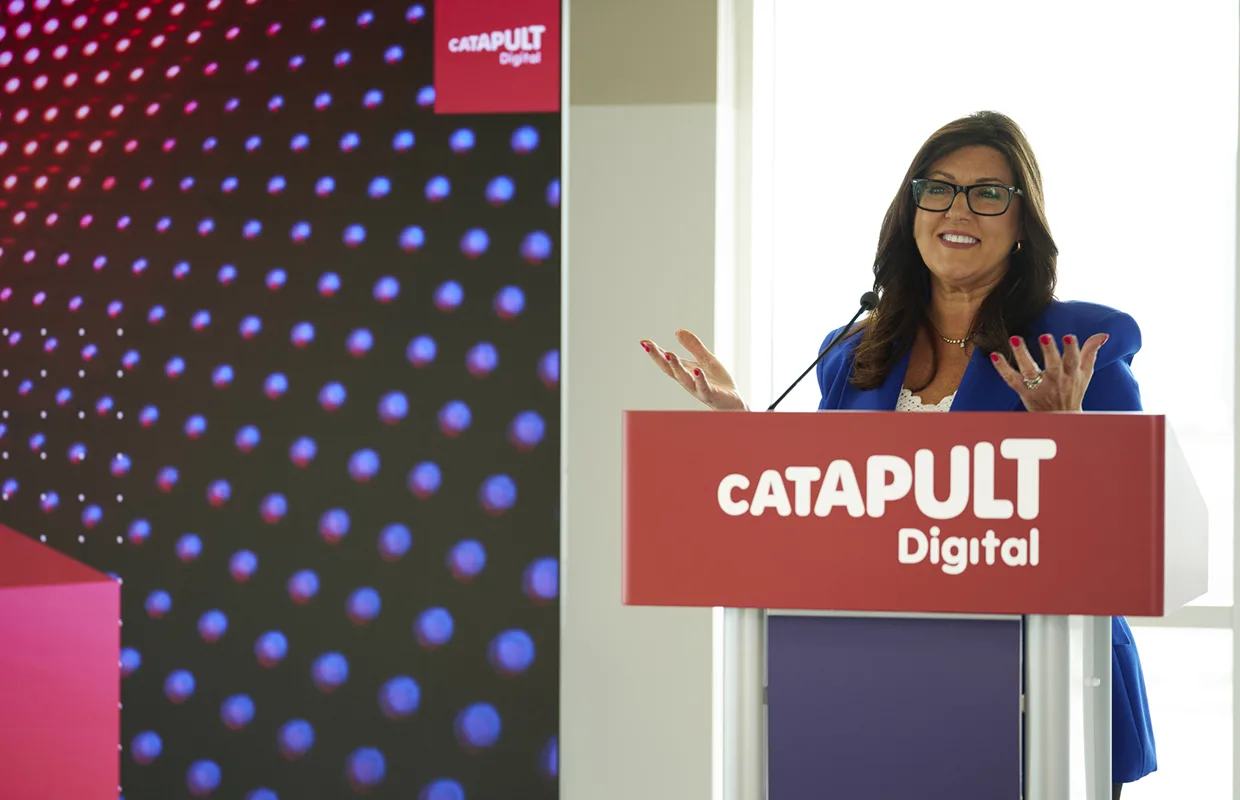
As the UK’s deep tech sector enters a new phase of industrial adoption, Digital Catapult is accelerating the deployment of artificial intelligence, digital twins, and advanced connectivity to drive regional growth, strengthen supply chains, and unlock real-world innovation across industry. Deborah Colville, National Director of Place, tells us more.
DEEP TECH, CATAPULTED
The UK’s technology sector finds itself at a point of critical inflexion, particularly in the realm of deep tech innovation.
It has evolved from a landscape rich in world-class research and academia, and into a more connected and delivery-focused ecosystem that is better equipped to translate innovation into real-world industrial impact.
“At Digital Catapult, we accelerate the practical application of deep tech innovation across industry and recognise that deep tech is no longer confined to academia but is instead being applied and adopted across high-growth sectors including energy and utilities, defence, and security and the creative industries,” opens Deborah Colville, National Director of Place, Digital Catapult.
The UK’s deep tech success is also underpinned by regional hubs of innovation in places such as Belfast, the North East and South West of England and Wales, and London, where deep tech capabilities are rooted in local talent, industry, and expertise.
At the same time, the convergence of technologies such as artificial intelligence (AI), digital twins, advanced connectivity, and quantum is creating significant opportunities to equip the UK to be future-ready.
Supported by growing investment from both government and industry, there are more opportunities to explore how deep technologies could converge to drive economic growth and develop new solutions that are necessary to unlock new commercial opportunities.
“For example, we’re starting to look into how AI and digital twins could unlock new opportunities for modelling and simulation, and how 6G and immersive technology could usher in a new era of media production,” she outlines.
For Colville, this is where real opportunity exists, and where intervention is necessary to deliver meaningful economic and social value.

TECHNICAL EXPERTISE, SECTOR-SPECIFIC INSIGHT
Digital Catapult’s role is to bridge the gap between cutting-edge innovation and real-world application, helping businesses adopt new solutions that deliver tangible value.
“We do this by combining technical expertise with sector-specific insight, creating environments where businesses can safely experiment, test, and validate new solutions that leverage deep tech innovation such as AI, digital twins, advanced connectivity, and quantum, before committing to full-scale deployment,” Colville states.
Digital Catapult focuses on the common barriers to adoption, such as risk, cost, integration, and access to skills, and addresses these through shared infrastructure, testbeds, and collaborative programmes that bring together start-ups, industry, and academia.
This has allowed organisations to explore how technologies can be applied to their specific challenges – weather optimising energy systems, enabling more resilient and responsive supply chains, accelerating defence capability, or unlocking new and creative experiences.
“As part of the Innovate UK Catapult Network (Innovate UK) – a world-leading group of technology and innovation centres – we also partner with other Catapults in our network to draw on catapult expertise, providing a broader and more strategic intervention where appropriate,” she details.
Crucially, Digital Catapult acts as a convener across these sectors, connecting the right partners, technologies, and expertise to move organisations from early exploration to practical implementation.
“By doing this, we enable deep tech companies to scale, strengthen UK industrial supply chain resilience, and accelerate the deployment and development of open and future networks across the country, ensuring that innovation is not only developed, but successfully adopted and scaled across the UK,” Colville insights.

AN IDEAL ENVIRONMENT FOR ACCELERATION
Digital Catapult’s new office in Bristol represents a significant step forward in strengthening the company’s place-based approach to innovation and supporting regional growth.
By establishing a presence in the South West of England and Wales, Digital Catapult is able to better connect organisations in the region to national and global innovation opportunities.
Known for its success in the creative industries and advanced engineering, Bristol’s strong academic institutions make it an ideal environment to accelerate the practical application of deep tech innovation.
“With our new office, we’re hoping to create a space where start-ups, industry, academia, and local government can come together to collaborate, validate new solutions, and enable deep tech companies in the region to scale,” Colville sets out.
In practical terms, the Bristol office will also enable Digital Catapult to deliver targeted programmes, build new partnerships, and provide access to the facilities, expertise, and networks that organisations need to adopt technologies like AI, advanced connectivity, and immersive tools to drive productivity and growth.
Looking ahead, the company’s ambition is to deepen its engagement across the region by supporting more cross-sector collaboration, strengthening links between local clusters and national initiatives, and helping unlock investment into high-potential businesses.
This ensures the South West of England and Wales continue to play a leading role in the UK’s deep tech landscape.
“As with other regions, I have been able to establish a Partnership Director from the region with a rich understanding of the West of England and Wales’ culture, strengths and long-term ambitions, which is an exciting new step,” she tells us.

“With our new office, we’re hoping to create a space where start-ups, industry, academia, and local government can come together to collaborate, validate new solutions, and enable deep tech companies in the region to scale”
Deborah Colville, National Director of Place, Digital Catapult
OPTIMISING COMPLEX SYSTEMS ACROSS SECTORS
Digital Catapult designs its innovation and acceleration programmes around real-world industry challenges, ensuring deep tech innovation is not developed in isolation, but shaped by the needs of the organisations that will ultimately adopt it.
“To achieve this, we work closely with partners across high-growth sectors to define specific use cases, and we then bring together start-ups, scale-ups, and technology providers to co-create and validate solutions in independent environments like testbeds to de-risk adoption and accelerate commercial deployment,” Colville says.
In the defence and security space, for example, Digital Catapult has partnered with the Ministry of Defence (MoD) on the Defence Testbed Accelerator programme.
This intervention saw five small to medium-sized enterprises (SMEs) in the technology sector access a virtual testbed environment to trial and validate a solution that could securely manage and share manufacturing design data, aiming to increase agility in the UK’s defence supply chain through enabling additive manufacturing (3D printing) processes.
The programme convened capabilities between defence and security leaders, as well as the innovators and original equipment manufacturers (OEMs), to practically apply the deep tech innovation in industry.
At Digital Catapult’s UK Digital Twin Centre in Belfast, the company is also working to demonstrate how digital twins can optimise complex systems across sectors, including aerospace, maritime, and defence.
“In collaboration with our partners, we are working to develop new digital twin solutions that can be applied to industry to unlock new opportunities, drive economic growth, and overcome challenges that inhibit progress and development,” she highlights.
By connecting innovators with industry and providing access to testbeds and expertise, Digital Catapult creates optimum conditions for collaboration so promising technologies can move beyond pilots and deliver measurable impact at scale with integrable solutions.
“In collaboration with our partners, we are working to develop new digital twin solutions that can be applied to industry to unlock new opportunities, drive economic growth, and overcome challenges that inhibit progress and development”
Deborah Colville, National Director of Place, Digital Catapult

DELIVERING RICHER, MORE INTERACTIVE EXPERIENCES
As it helps businesses harness technologies like haptics and digital twins, Digital Catapult is creating environments where immersive experiences can be designed, tested, and refined with real users and real-world applications in mind.
For example, the company is currently delivering the first digital twin accelerator programme at its UK Digital Twin Centre in Belfast in the hope of assessing how deep tech innovation can deliver richer, more interactive experiences.
“This may range from prototyping new assets to creating new solutions to upskill and train staff,” Colville points out.
By providing access to cutting-edge infrastructure, expertise, and collaborative networks, Digital Catapult enables organisations to prototype and validate immersive solutions that integrate physical feedback with real-time data and virtual environments.
“This is critical in helping them understand not just what’s technically possible, but what delivers genuine value for their partners,” she adds.
Crucially, the company also supports the development of standards, use cases, and business models that allow these technologies to scale beyond pilots, ensuring haptics and digital twins progress from emerging innovations into practical tools that can transform high-growth sectors and unlock new opportunities.
CONVENING FUTURE CAPABILITIES
Moving forwards, Digital Catapult will continue to play a central role in accelerating the UK’s adoption of deep tech, with a growing focus on translating innovation into measurable economic and societal impact at scale.
“Our priority is to deepen our place-based approach to innovation, expanding our presence across key regions to better connect local strengths with global opportunities, whilst continuing to invest in the infrastructure, programmes, and partnerships that enable industry to adopt technologies like AI, digital twins, advanced connectivity, and quantum,” Colville excites.
As such, the company will increasingly focus on convening capabilities to solve major industrial challenges – from resilient supply chains and sustainable energy systems to next-generation defence capability and immersive experiences, ensuring innovation is driven by real-world needs and delivered through collaboration.
“At the same time, we’ll continue to support start-ups and scale-ups to access markets and investment, whilst helping established organisations de-risk and accelerate adoption, strengthening the UK’s position as a global leader in deep tech,” she details.
Ultimately, Digital Catapult’s role is to ensure the UK not only develops cutting-edge technologies but also successfully deploys them across the economy, equipping the industry to be more productive, resilient, and future-ready.
Additionally, it will be crucial in translating the UK’s innovation ambitions into real-world outcomes, supporting deep tech companies from early-stage innovation through to scale-up and commercial deployment.
By aligning closely with national priorities set out by Innovate UK, Digital Catapult will help build the capabilities, infrastructure, and partnerships required to grow globally competitive businesses whilst strengthening regional innovation communities across the nation.
“This place-led approach will be central to driving regional growth and unlocking the full economic potential of deep tech, ensuring that innovation is not only developed but scaled across the country,” Colville passionately concludes.
COLLABORATIVE R&D PIPELINE
Digital Catapult’s approach to building confidence and opening new markets is multifaceted, drawing on over a decade of experience creating trusted environments where deep tech innovation is trialled and applied in real-world environments, establishing a sustainable path from concept to commercialisation.
Through its interventions centred around collaborative research R&D, the company brings together suppliers and industry partners to co-develop and trial solutions against clearly defined challenges.
This enables them to demonstrate performance, interoperability, and value in operational settings rather than in isolation.
This not only helps to de-risk adoption for end-users but also provides suppliers with credible validation, reference use cases, and routes into complex markets that can otherwise be difficult to access, particularly in sectors such as defence, energy, and manufacturing.
By providing access to shared infrastructure, testbeds, and secure environments, alongside convening the right mix of partners across sectors, the company helps suppliers move beyond proof of concept towards scalable deployment, whilst also shaping standards, frameworks, and best practices that give the industry greater confidence to adopt new technologies.
For example, Digital Catapult’s AI Adoption Toolkit – which was developed as part of the Innovate UK BridgeAI programme – helps organisations benchmark and accelerate their AI and machine learning (ML) adoption, guiding AI strategy and sustainable deployment.
This article was produced by the editorial team at EME Outlook and published as part of the Outlook Publishing global network of B2B industry magazines.
Outlook Publishing delivers industry insights, company stories, and sector coverage across manufacturing, mining, construction, healthcare, supply chains, food production, and sustainability.
EME Outlook provides ongoing coverage of organisations and developments shaping industries across Europe and the Middle East.