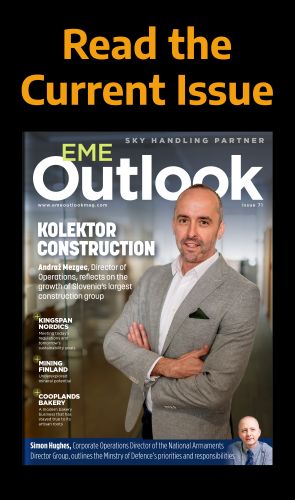





Working for a secure and prosperous UK, the Ministry of Defence is dedicated to ensuring the country’s security, supporting national interests, and safeguarding prosperity. Simon Hughes, Corporate Operations Director of the National Armaments Director Group, tells us more about the ministry’s priorities and responsibilities.
DEFENCE CAPABILITIES FROM CONCEPT TO FRONT-LINE DEPLOYMENT
Bringing nearly 30 years of industry experience working in the defence, oil and gas, power generation, and rail sectors, Simon Hughes, Corporate Operations Director of the National Armaments Director Group (NAD Group), is an industry stalwart, proudly representing the UK’s interests and protection.
“My career has taken me through some of the most technically complex and consequential industries in the world – from aerospace and power generation to oil and gas, rail, and now defence,” he introduces.
“At each stage, I have been drawn to the challenge of making large, mission-critical organisations deliver at pace and at scale – not just efficiently, but with genuine engineering and operational rigour.”
Starting as an apprentice at BAe Systems gave Hughes a grounding that has stayed with him throughout his career – an understanding that the best outcomes combine technical excellence with strong programme discipline and a deep respect for the people doing the work.
After studying aerospace engineering and spending time abroad leading design and development programmes for offshore gas turbine equipment, Hughes returned to the UK as General Manager, responsible for a development and manufacturing site. This experience reinforced the importance of supply chain resilience, workforce capability, and integrated delivery – lessons that proved to be directly applicable to what is being built at the NAD Group today.
“When I joined defence, I recognised immediately that the same principles applied, but at an entirely different scale and with stakes that couldn’t be higher,” details Hughes.
“Being part of defence, at a time when the global threat is as serious as at any point in my career, makes this work feel both urgent and historic.”
Leading this historic path is the NAD Group, which was established in March 2025 as part of the most significant reform of the Ministry of Defence (MOD) in more than half a century. Headed by National Armaments Director Rupert Pearce, the group unites the MOD organisations responsible for developing, delivering, sustaining, housing, and harbouring the UK’s national arsenal and defence estate.
The organisation operates across multiple UK locations and comprises key enabling teams specialising in defence innovation, science, logistics and support, procurement, digital and data, infrastructure, international and exports, commercial and industry collaboration, and corporate services.
“The final area – corporate – is where I focus my energy; it exists to provide an integrated and streamlined service for the NAD Group National Armaments and the wider MOD. By bringing together expertise and services from across the group, we’ve created a unified, leaner, and more efficient structure that underpins everything the NAD Group does,” Hughes insights.
“Without the right foundations in place, even the best-designed acquisition programmes will struggle to deliver at the pace and scale now required.”
STRENGTHENING STRATEGIC ENGAGEMENT
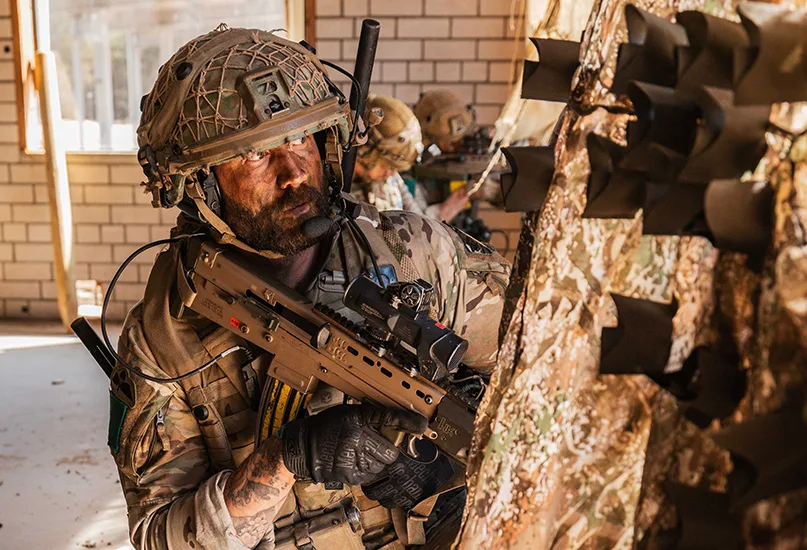
The NAD Group’s mission is to maximise its war fighters’ collective ability to operate, deter, fight, and win – from the earliest scientific research through to procurement, in-service support, and the moment a capability reaches its armed forces and allies on the front line.
“By bringing science, procurement, infrastructure, digital, and support expertise into a single group, we can move faster, reduce duplication, and ensure what we deliver is genuinely integrated,” expands Hughes.
Eliminating fragmentation, breaking down silos, and making faster decisions is central to what the NAD Group exists to do. Its work is closely aligned with the Strategic Defence Review (SDR), which drives its national ambition to be a leading, tech-enabled defence power.
“My engineering and programme management background means I understand from direct experience what integrated delivery looks like in practice and what happens when it breaks down. National Armaments Corporate plays a direct role in enabling this,” Hughes furthers.
The SDR calls for increased resilience, readiness, and pace driven by partnership and collaboration. For the corporate team, meeting that ambition means a culture of functional integration, i.e. removing barriers between teams, eliminating duplication, and replacing fragmented delivery with strategy-led ownership and enabled execution.
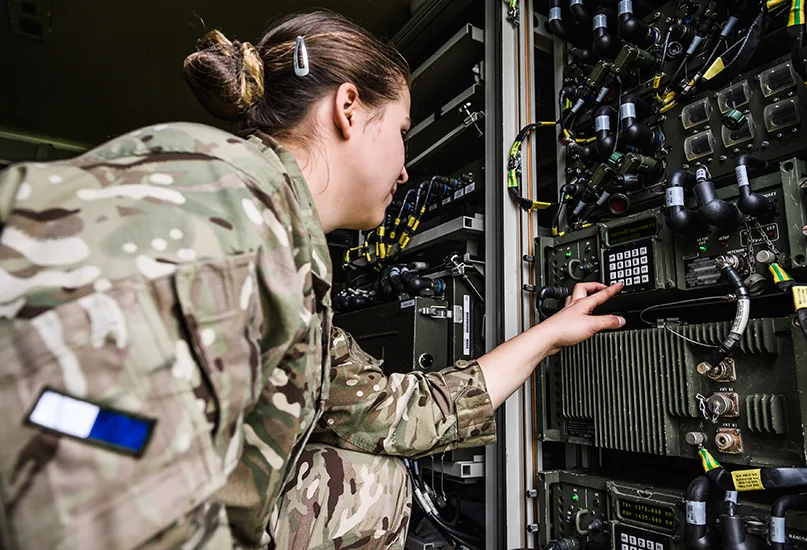
This is not administrative overhead, but rather the connective tissue that allows the rest of the NAD Group to operate with coherence and speed.
Currently, the organisation’s priorities reflect both the urgency of the current threat environment and the longer-term transformation required. This entails building a competitive armaments ecosystem; designing and delivering the right capabilities to give armed forces the edge; driving economic growth through exports, employment, and economic security; and increasing productivity and efficiency.
“Within corporate, this focus on efficiency is structural. We’ve consolidated services across six directorates – covering strategy, shared services, people, security, resilience, and corporate operations – into a single coherent reporting structure,” outlines Hughes.
A common planning tool aligns demand and supply across the group, and a single version of truth for data and management information provides leadership with a clear, real-time picture of performance.
These are more than just aspirations; they are operational realities being actively built and scaled.

“We have an ambition to double UK defence exports by 2035, and this is not simply a commercial target – it reflects our belief that strong industrial relationships between allies and partners are themselves a form of deterrence”
Simon Hughes, Corporate Operations Director, National Armaments Director Group
ENTERPRISE-WIDE COORDINATION
The NAD Group’s ambition extends well beyond traditional defence contractors.
“We recognise that some of the most transformative capabilities available to our armed forces will come from industries that do not currently think of themselves as defence suppliers, and we want to change that,” Hughes notes.
Sectors including advanced manufacturing, energy technology, artificial intelligence (AI), cybersecurity, and financial services all have a direct role to play in building a more capable, resilient defence enterprise.
The NAD Group is committed to making it easier for businesses from these sectors to engage with the organisation, compete for work, and grow through their relationship with defence. Its newly created National Armaments International team is specifically designed to accelerate those partnerships, open new export pathways, and deepen relationships that underpin collective security.
“We have an ambition to double UK defence exports by 2035, and this is not simply a commercial target – it reflects our belief that strong industrial relationships between allies and partners are themselves a form of deterrence,” explains Hughes.
Another area the organisation is proud of is the reform of how it manages major defence acquisition programmes. Moving away from vertical silos towards an enterprise-wide approach organised across capability portfolios, spanning land, sea, air, space, and digital, has enabled the NAD Group to share technology, reduce duplication, and accelerate delivery.
The corporate team’s role in this is to ensure the organisational infrastructure keeps pace with the operational ambition. That means having the right governance, data, and people in place and ensuring the services colleagues rely on every day are simple, consistent, and effective.
The organisation’s Corporate Portal was recently launched to over 14,500 users, bringing together more than 36 services. This is a practical expression of the NAD Group’s commitment to simplifying the employee experience and directing more time and effort towards mission-critical work.
“The UK’s NATO-first commitment runs through everything we do – ensuring what we buy is interoperable with our allies and that we are active contributors to collective security,” Hughes insights.
“On sovereign resilience, the Defence Industrial Strategy makes clear that a strong domestic industrial base is a strategic asset. The work to support Ukraine has sharpened our thinking; the pace of that conflict has reinforced the importance of having a defence industry that can respond at speed.”
“Our ambition is to make the NAD Group genuinely fit for a world in which threat evolves faster than traditional acquisition cycles can respond”
Simon Hughes, Corporate Operations Director, National Armaments Director Group

DRIVING FUTURE INNOVATION
Ultimately, the scale and pace of what the NAD Group is hoping to accomplish is unprecedented in modern UK defence.
What Hughes learnt across nearly 30 years in complex, high-stakes industries is that transformation only succeeds when people understand the purpose, see their role within it, and feel supported. Getting the corporate foundations right is not separate from the operational mission – it’s what makes the operational mission possible.
“Our ambition is to make the NAD Group genuinely fit for a world in which threats evolve faster than traditional acquisition cycles can respond,” asserts Hughes.
“That means hardwiring innovation through the work of National Armaments Innovation teams, developing deeper partnerships with industry and academia, and embracing AI, digital engineering, and new manufacturing technologies as tools we deploy today – not future aspirations.”

The organisation is already applying AI-enabled analysis to accelerate research and provide faster intelligence to decision-makers, and its digital and data teams are deploying automation tools to streamline complex systems management.
Within the corporate team, its digital capability is driving the same transformation – leading AI and automation delivery, secure-by-design principles, and data quality to ensure the group’s internal operations are as forward-looking as its external programmes.
It also means building an organisation where the best people want to work and can thrive, regardless of their background. Inclusive culture is not a side programme for the group; it’s a prerequisite for the innovative, mission-focused delivery needed.
“A strong people directorate, coherent workforce strategy, and genuine commitment to reward, recognition, and talent development are the foundations on which that culture is built,” concludes Hughes.
“As UK defence spending rises, every pound must be spent with maximum effectiveness and minimum waste. The NAD Group – and corporate within it – exists to make that happen.”
This article was produced by the editorial team at EME Outlook and published as part of the Outlook Publishing global network of B2B industry magazines.
Outlook Publishing delivers industry insights, company stories, and sector coverage across manufacturing, mining, construction, healthcare, supply chains, food production, and sustainability.
EME Outlook provides ongoing coverage of organisations and developments shaping industries across Europe and the Middle East.