




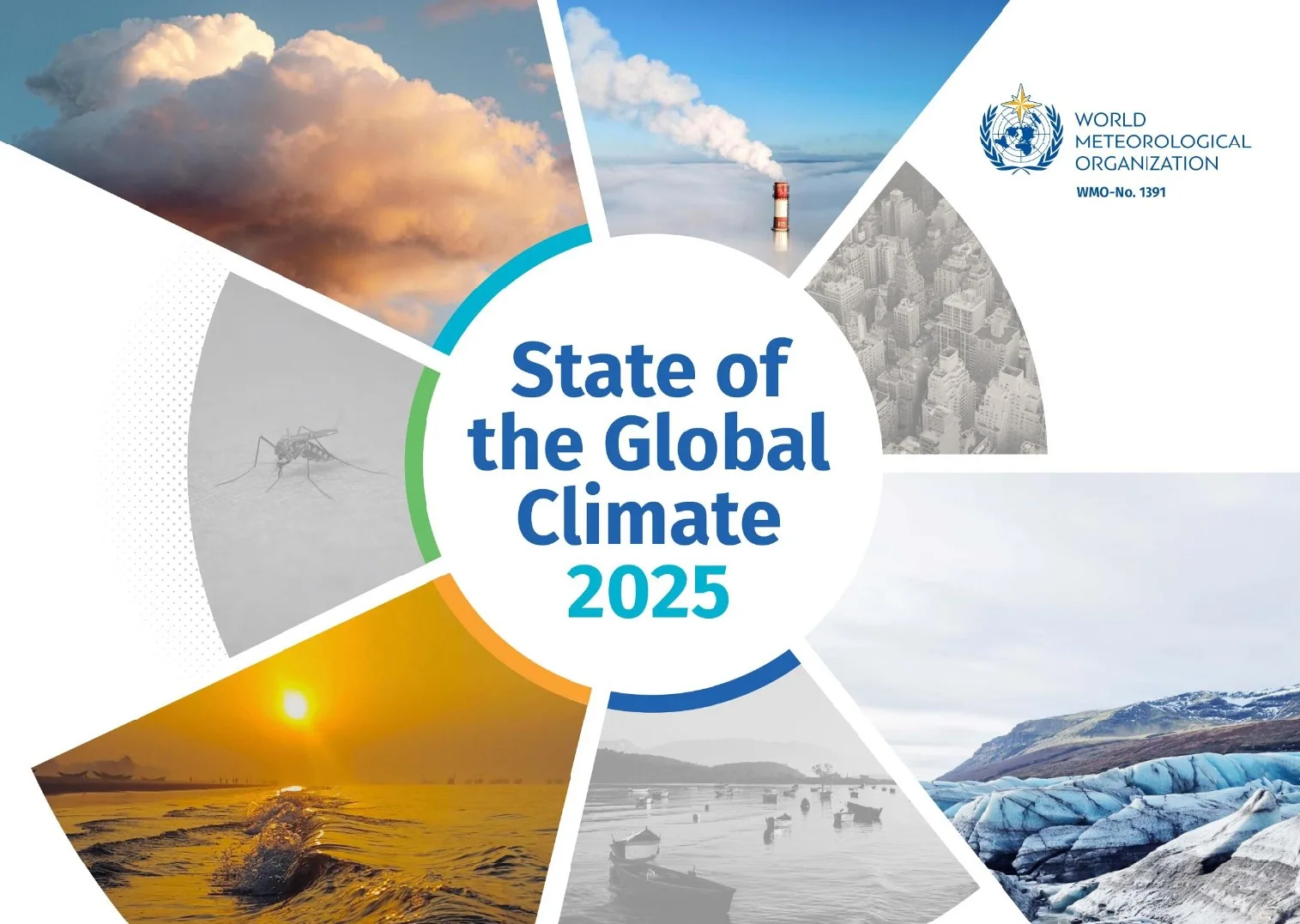
Rapid change affecting global economies
Record temperatures and climate indicators
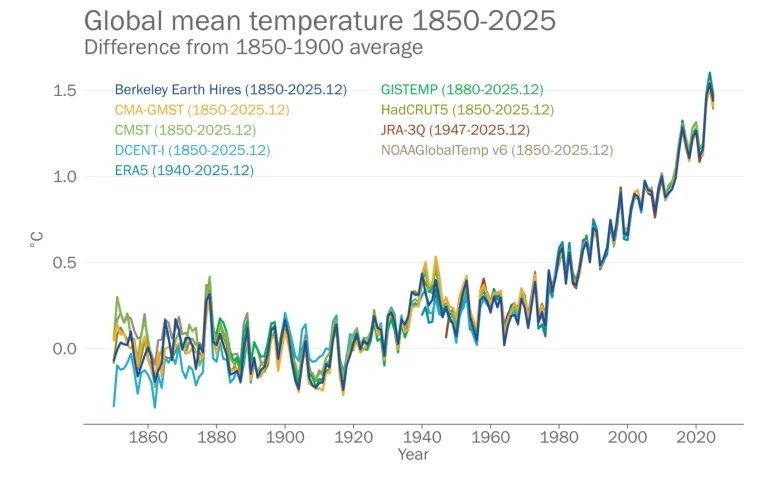
According to WMO, the period from 2015 to 2025 represents the eleven warmest years on record. The globally averaged temperature in 2025 was about 1.43°C above the 1850–1900 pre-industrial average.
Extreme weather events—including heatwaves, heavy rainfall and tropical cyclones—caused widespread disruption during the year, demonstrating the vulnerability of interconnected economies and societies.
“The State of the Global Climate is in a state of emergency. Planet Earth is being pushed beyond its limits. Every key climate indicator is flashing red,” said António Guterres, Secretary-General of the United Nations.
“Humanity has just endured the eleven hottest years on record. When history repeats itself eleven times, it is no longer a coincidence. It is a call to act.”
Earth’s energy imbalance reaches record levels
For the first time, WMO’s flagship climate report includes Earth’s energy imbalance as a key climate indicator.
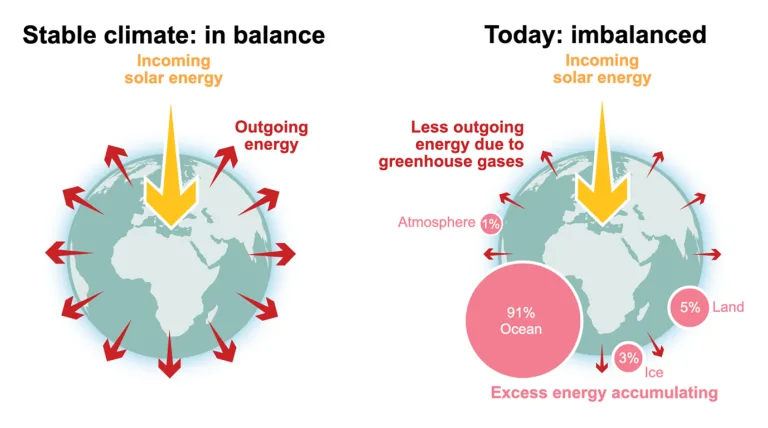
The measure tracks the difference between energy entering the Earth system from the sun and energy leaving the planet. Under a stable climate these levels are roughly equal, but rising greenhouse gas concentrations have disrupted this balance.
Carbon dioxide, methane and nitrous oxide concentrations have reached their highest levels in at least 800,000 years, driving a growing imbalance that reached a new high in 2025.
“Scientific advances have improved our understanding of the Earth’s energy imbalance and of the reality facing our planet and our climate right now,” said Celeste Saulo, Secretary-General of the World Meteorological Organization.
“Human activities are increasingly disrupting the natural equilibrium and we will live with these consequences for hundreds and thousands of years.”
How oceans absorb heat
The report shows that the oceans continue to absorb the majority of the planet’s excess heat. More than 91% of excess heat is stored in the ocean, helping to buffer temperature increases on land.
Ocean heat content reached a new record in 2025, and the rate of warming has more than doubled between the periods 1960–2005 and 2005–2025.
Over the past two decades, the ocean has absorbed heat equivalent to around eighteen times the annual human energy use each year.
Despite La Niña conditions, around 90% of the ocean surface area experienced at least one marine heatwave in 2025, according to the report.
Melting ice and rising sea levels
Melting ice sheets and glaciers continue to contribute to rising sea levels.
Both Antarctica and Greenland have lost significant ice mass, while Arctic sea ice reached either the lowest or second lowest annual average extent since satellite records began in 1979.
Glacier loss also accelerated, with exceptional levels recorded in Iceland and along the Pacific coast of North America in 2025.
Global mean sea level in 2025 was comparable to the record highs recorded in 2024 and now sits around 11 cm higher than at the start of the satellite altimetry record in 1993.
Ocean warming and melting ice are expected to drive sea-level rise for centuries.
Climate impacts on economies and communities
Extreme weather events in 2025—including heatwaves, droughts, wildfires, storms and flooding—caused thousands of deaths, affected millions of people and generated billions in economic losses.
“On a day-to-day basis, our weather has become more extreme. In 2025, heatwaves, wildfires, drought, tropical cyclones, storms and flooding caused thousands of deaths, impacted millions of people and caused billions in economic losses,” adds Celeste Saulo.
The report also notes that climate stress can have cascading impacts on food security, migration and economic stability.
“In this age of war, climate stress is also exposing another truth: our addiction to fossil fuels is destabilizing both the climate and global security. Today’s report should come with a warning label: climate chaos is accelerating and delay is deadly,” continues António Guterres.
Climate data and decision-making
The report is intended to support decision-making by governments, businesses and institutions and is based on scientific contributions from national meteorological services, WMO regional climate centres, United Nations partners and dozens of experts.
“WMO’s State of the Global Climate report seeks to inform decision-making. It is in keeping with the theme of World Meteorological Day because when we observe today, we don’t just predict the weather, we protect tomorrow. Tomorrow’s people. Tomorrow’s planet,” said Celeste Saulo.