




New research from Boston Consulting Group reveals growing tension between CEOs and corporate boards over AI transformation, with many executives warning that pressure to accelerate adoption may be outpacing organisational readiness.
Key Developments
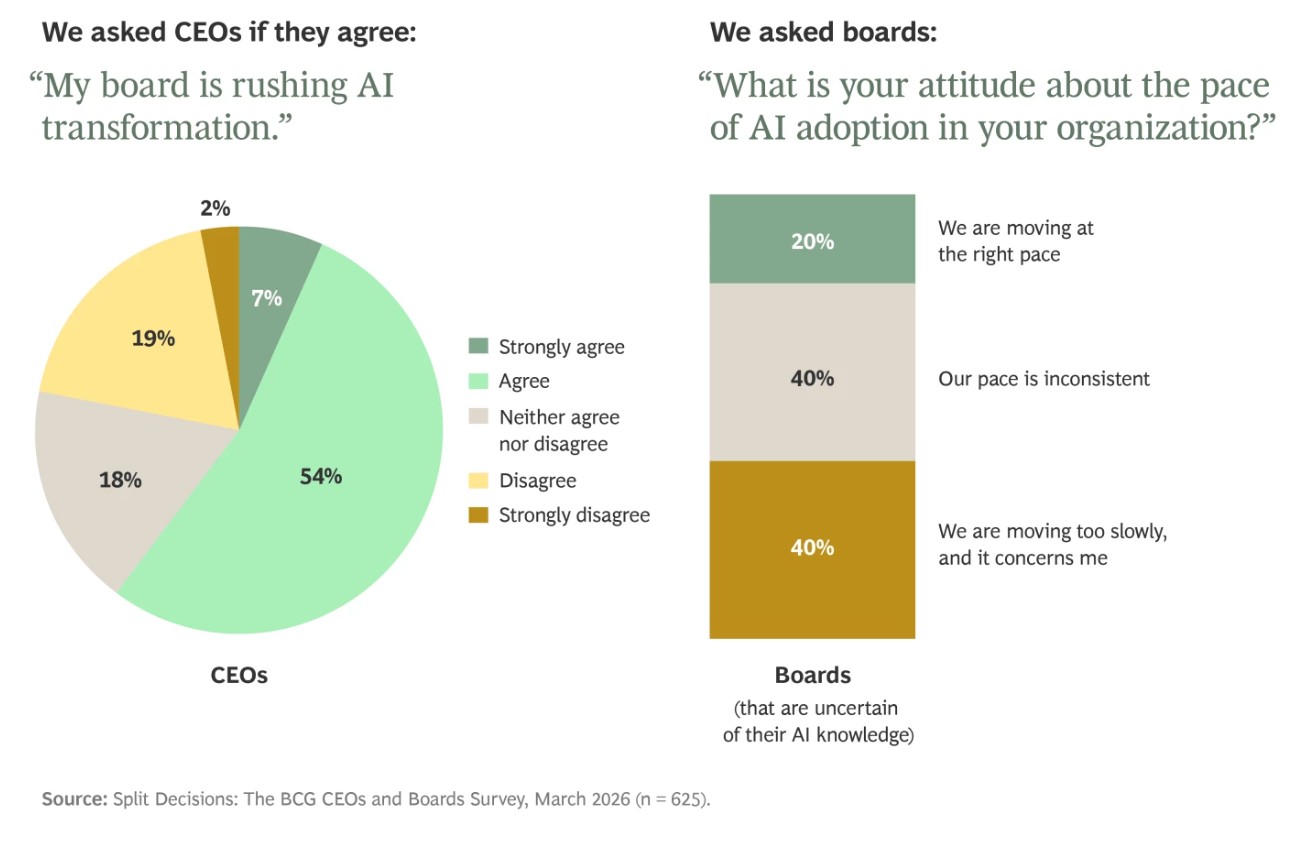
- 61% of CEOs say boards are rushing AI transformation initiatives
- More than half of CEOs believe AI hype is influencing boardroom decision-making
- 75% of board members say they understand AI at peer level or above
- Nearly 40% of CEOs say boards lack an informed view of AI’s impact on growth strategy
- Both CEOs and boards agree AI literacy must improve at leadership level
AI Ambitions Expose Leadership Misalignment
A new global survey from Boston Consulting Group highlights a widening divide between CEOs and corporate boards over how quickly organisations should scale AI transformation initiatives.
According to the firm’s first Split Decisions: The BCG CEOs and Boards Survey, 61% of CEOs believe their boards are pushing AI transformation too aggressively, despite shared agreement that AI will play a central role in future business strategy.
The research surveyed 625 business leaders, including 351 CEOs and 274 board members, from organisations with annual revenue exceeding $100 million across public and private sectors.
Boards Push for Speed While CEOs Focus on Execution Reality
The study found that boards generally favour faster AI implementation, while CEOs tend to take a more cautious and operationally grounded approach.
BCG suggests that gaps in AI understanding may be contributing to this dynamic. Board members with lower confidence in their AI knowledge were more likely to believe their organisations were moving too slowly on adoption.
At the same time, many CEOs expressed concerns about inflated expectations surrounding AI capabilities and implementation timelines.
Confidence Gap Emerges Around AI Understanding
While 75% of board members surveyed said their AI knowledge was comparable to or ahead of their peers, CEOs appeared significantly less confident in board-level understanding.
Nearly 40% of CEOs said boards lack an informed view of how AI is reshaping corporate growth strategy, while approximately one-third said boards overestimate the extent to which AI can replace human capabilities.
“I feel this tension so acutely between CEOs and boards,” said Julie Bedard, a BCG managing director and partner.
“A powerful way for CEOs to bridge the gap between their AI knowledge and their boards’—especially if they feel there is a deficit there—is for the CEO to personally lead an AI upskilling session for their board to show them the latest AI tools and what they can do. CEOs can also bridge the gap by talking about AI in a much more differentiated way to clearly illustrate where AI can be a substitute for humans and where it can complement human work.”

AI Hype Continues to Shape Boardroom Expectations
The survey also found that more than half of CEOs believe boards need a stronger understanding of the gap between AI hype and operational reality.
At the same time, boards indicated that CEOs could do more to communicate and justify their AI strategies.
Perceptions of accountability also differed between the two groups. CEOs estimated that 35% of their performance evaluations are tied to AI return on investment, while boards estimated the figure at 27%, highlighting a disconnect in perceived pressure and expectations.
AI Literacy Becomes a Governance Priority
Despite differing views on implementation pace, CEOs and board members broadly agreed on the importance of strengthening AI fluency at leadership level.
Approximately 80% of both groups said future board members should demonstrate measurable understanding of how AI could reshape their industries.
“CEOs need to be very intentional about supporting their boards on the same learning journey they’ve taken,” said Judith Wallenstein, a BCG managing director and senior partner and the global head of the firm’s CEO Advisory.
“But at a much faster pace, with more focus, and in a way that builds real understanding rather than just surface-level awareness of how AI can create true competitive advantage for the company.”