



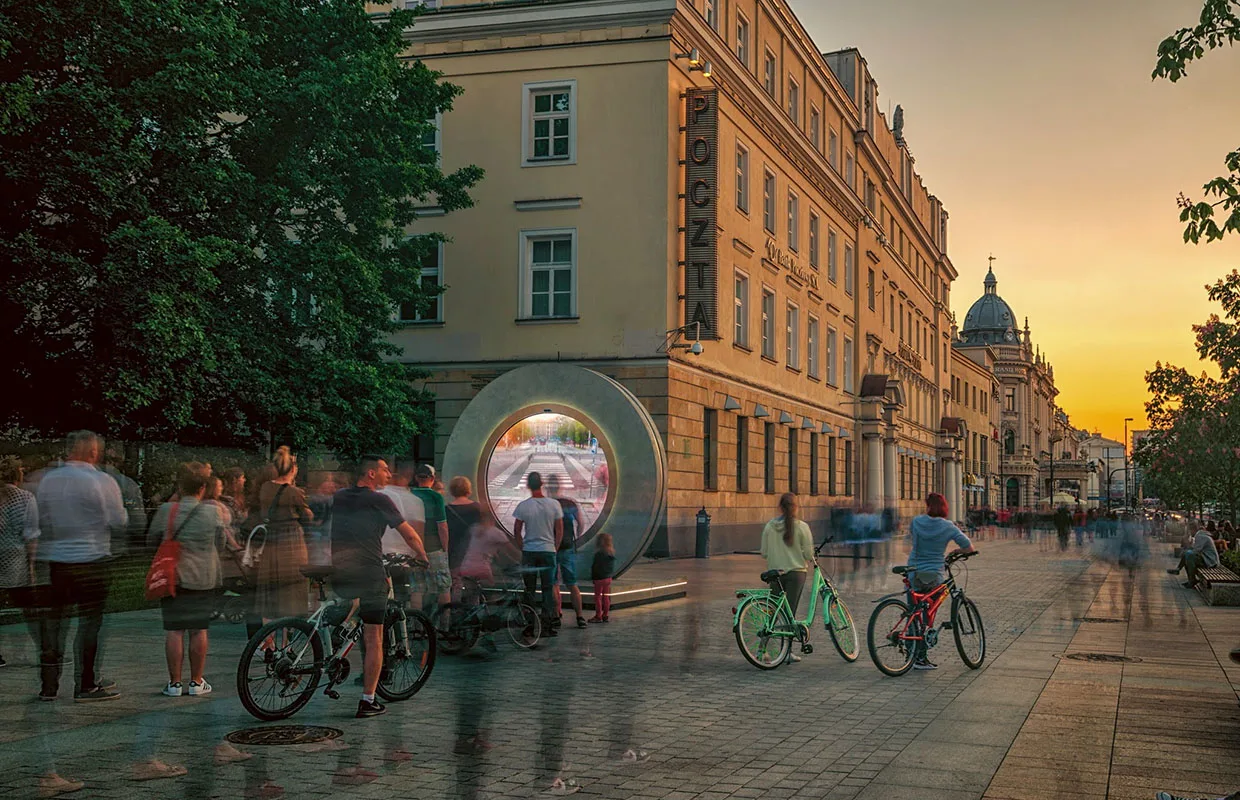
In a world of increasingly polarising narratives, Portals are technology art sculptures that allow people to connect above borders and labels and meet fellow humans from across the globe. We connect with Nicolas Klaus, Partner and Chief of Growth at Portals Organization.
BRIDGE TO A UNITED PLANET
“In the age of artificial intelligence (AI), algorithms, and a constant chase for the next hit of dopamine, Portals deliver an alternative approach.”
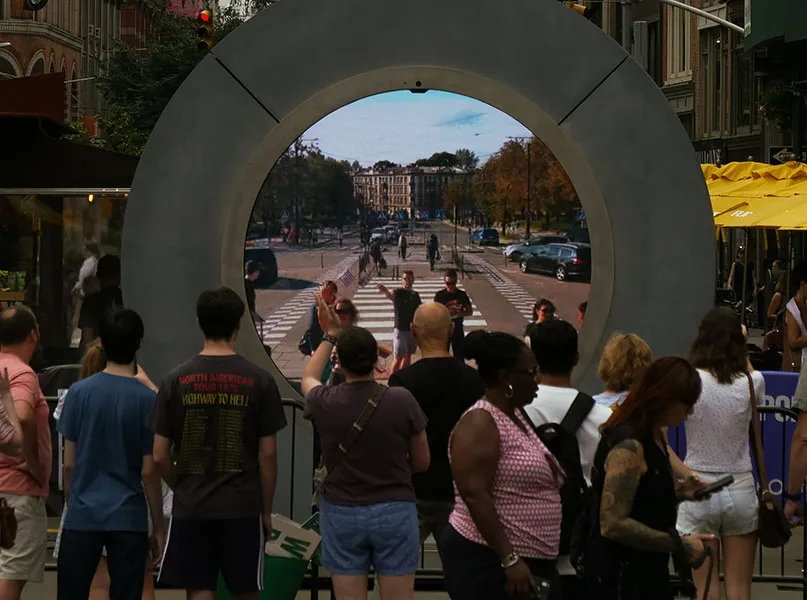
These large-scale technology sculptures, intended as lasting monuments at notable locations in the public space, serve a pure window – without features, imposed narratives, and rules – simply showing reality as it is.
The centre screen provides a 24/7 livestream that connects to identical Portals in other countries and rotates every three minutes between all participating locations.
“Whilst the technology may seem simple, there is quite some complexity in maintaining a growing number of Portals, which are constantly active and in the public eye, located in high-footfall locations, and across diverse climatic conditions,” explains Nicolas Klaus, Partner and Chief of Growth at Portals Organization.
REAL MOMENTS OF CONNECTION
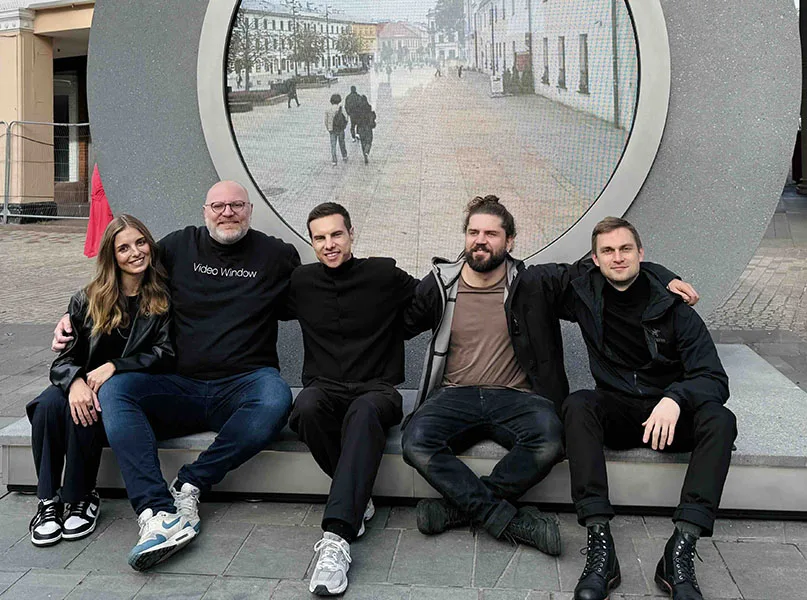
Based in Vilnius, Lithuania and Berlin, Germany, Portals Organization is the company behind the development, fabrication, and upkeep of the global Portals network.
The origins of Portals go back to 2016 when Founder, Benediktas Gylys, an accomplished tech entrepreneur, went through an episode of deeply questioning reality.
This led him to a mystical experience of feeling oneness with all life on Earth, and Portals became the medium through which this experience was manifested and shared.
Benediktas funded the early development through his private foundation and drew together a team of supporters in Lithuania to create the first two Portals, which opened in Vilnius and Lublin, Poland in 2021.
“Personally, I joined the project later that year. Together, with a small core team, we incorporated Portals Organization, with the purpose of growing Portals into a global artwork,” recalls Klaus.
One of the key challenges has been to align the artistic and philanthropic essence of Portals with a business model that would generate the necessary funding for its expansion and upkeep.
“We re-engineered Portals from the ground up in Berlin and secured funding from several public and private organisations who, thanks to their visionary leadership, were able to see the value of hosting Portals in their cities at a time when this still seemed like a crazy idea to many,” he tells us.
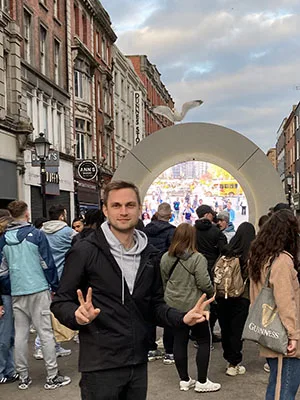
This resulted in the opening of Portals in Dublin, Ireland; New York, US; and Ipswich, UK – generating billions of online impressions and real moments of connection between people who otherwise would have never met.
“You can think of Portals in terms of multiple layers – the sculptures themselves provide the platform, but another layer emerges from people’s interactions and the thousands of moments of connection that happen every day. Many of these encounters are published to social media, where they result in millions of impressions,” Klaus highlights.
“In the age of AI, algorithms, and a constant chase for the next hit of dopamine, Portals deliver an alternative approach”
Nicolas Klaus, Partner and Chief of Growth, Portals Organization
WHY IPSWICH?
The UK’s first-ever Portal in Ipswich was recently launched in October 2025 and followed a two-year planning process, enabled through the Towns Deal funding from the UK government.
“Many cities across the UK have these beautiful town centres, which have become much less active – especially following the COVID-19 pandemic,” notes Klaus.
In response, the UK government launched initiatives to vitalise town centres and strengthen community building in the public space.
This was an important piece of the puzzle to enable the Ipswich Portal, but it also required a lot of dedication and an open mind from key people at Ipswich Borough Council.
“Some people have been asking, “Why Ipswich?”, and the answer is because Ipswich was ready to receive it. We rarely reach out to cities proactively, mainly because there needs to be a critical mass of ‘readiness’ to receive a Portal,” Klaus outlines.
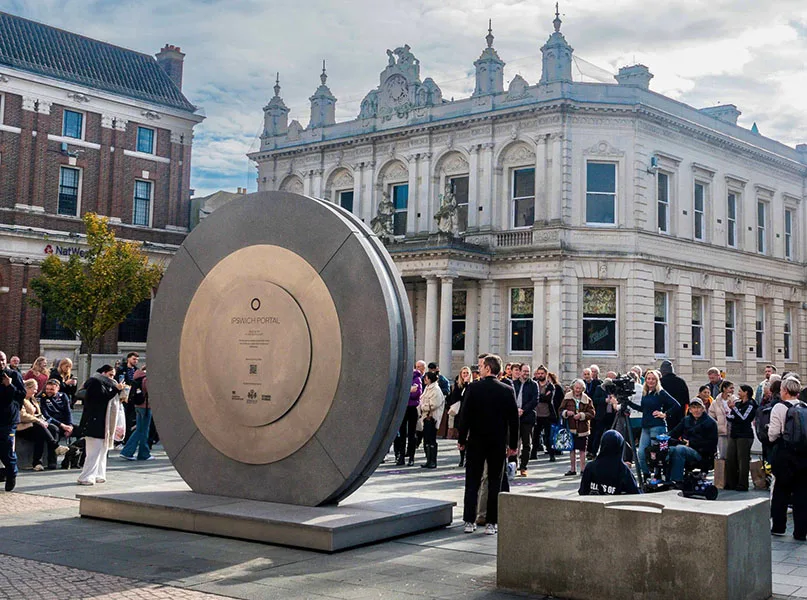
“It’s also worth noting that Ipswich is one of the oldest towns of England with a beautiful historic city centre where the Portal is now located.”
Evidently, there needs to be an understanding of what Portals are and the value hosting one creates.
“With most of our key partners, it becomes a legacy project, and they work with a high degree of agency and vision. It’s not easy because you tend to have layer upon layer of committees and bureaucratic red tape, which needs sufficient motivation and knowledge to break through,” emphasises Klaus.
At the same time, with each new Portal that opens, it becomes easier as processes are standardised and perceptions change – from Portals being a crazy idea to a reality that needs to happen.
“You can think of Portals in terms of multiple layers – the sculptures themselves provide the platform, but another layer emerges from people’s interactions and thousands of moments of connection that happen every day. Many of these encounters are published to social media, where they result in millions of impressions”
Nicolas Klaus, Partner and Chief of Growth, Portals Organization
GROWING NETWORK
Portals will be launched in four new countries this year, and Portals Organization has various technical development goals to ensure it can reliably maintain this growing network 24/7.
This means by the end of 2026, there should be a total of nine Portals on four continents, all operating with minimal downtime, facilitating tens of thousands of on-site interactions and millions of online impressions.
In January this year, the very first Asian Portal debuted in Manila, Philippines, whilst South America’s first Portal is currently being shipped and will open in spring in Piauí, Brazil.
“A third Portal is planned in another well-known Asian city – to be announced soon,” teases Klaus.
On the partnerships side, it is also looking to realise four collaborations with major brands or cultural institutions to launch memorable global experiences through Portals.
“We’re increasingly looking into partnerships to co-create events at Portals and do joint storytelling together online,” he confirms.
For example, Portals Organization recently partnered with UK-based space company SEN, who have HD cameras installed at the International Space Station and provide a live feed of planet Earth that is now occasionally visible on the Portals.
“This is a natural partnership since the essence of Portals is the insight that we are all one, inseparably connected in this world – an insight that becomes undeniable when viewing planet Earth from space.
“We also partnered with Chess.com for an international chess tournament through Portals for International Chess Day back in July, and we are in contact with many brands and organisations to create meaningful moments together,” Klaus closes.