



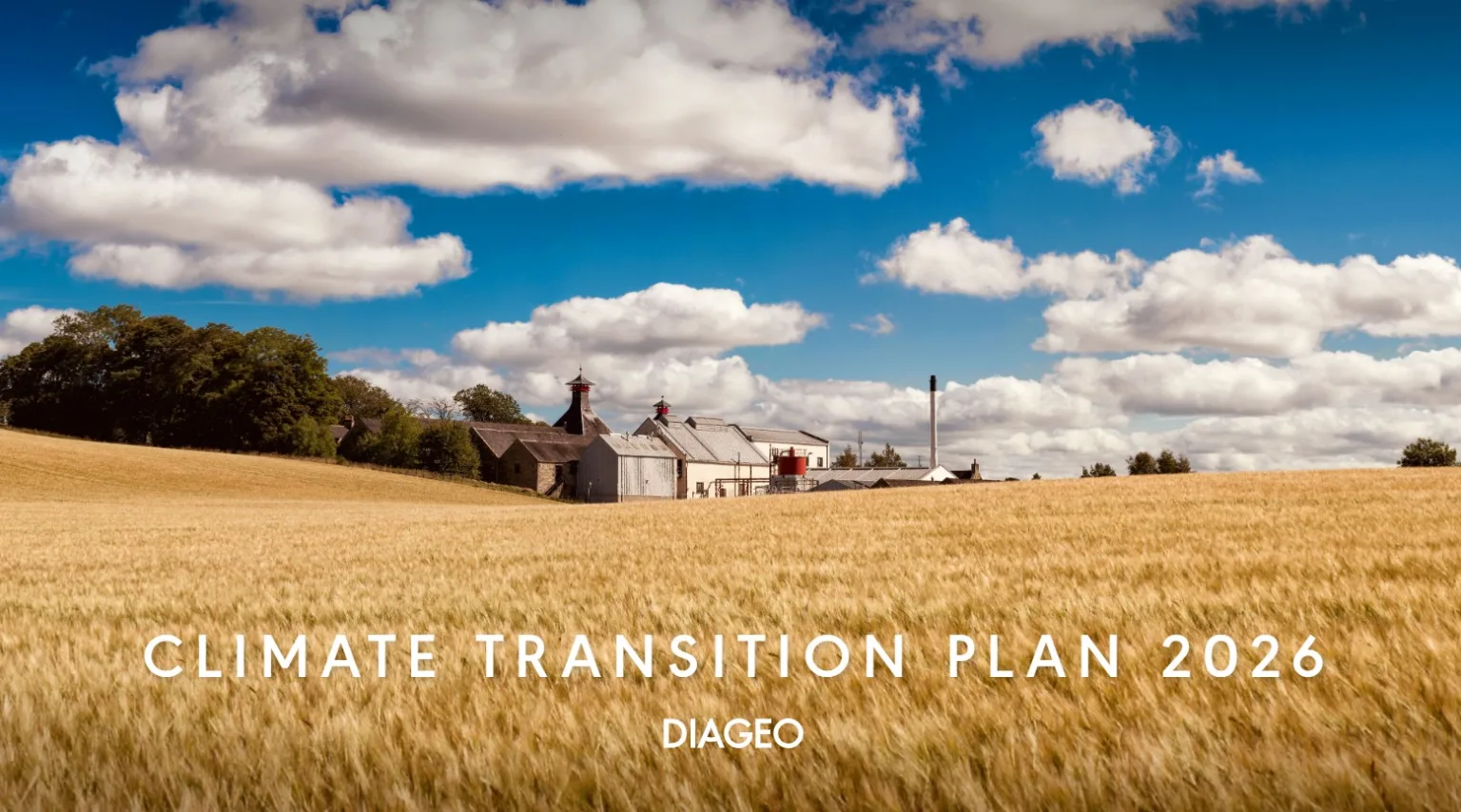
Global beverage producer Diageo has unveiled a new Climate Transition Plan (CTP) outlining how the company intends to reduce emissions across its operations and value chain while preparing the business for a low-carbon and climate-resilient future.
- Embedding climate action across operations
- The three core principles
- “Fundamental to the way we choose to do business”
- A strategy built on mitigation and adaptation
- Why collaboration key to delivering climate goals
- Building a climate-resilient value chain
- Supply chain: Working with suppliers to reduce value chain emissions
- Key focus areas when engaging with suppliers
- Case Study: Johnnie Walker Ultra – The first ultra-lightweight whisky bottle
- Case Study: Regenerative barley farming in Ireland for Guinness
Embedding climate action across operations
The strategy builds on the company’s existing climate commitments and integrates climate considerations into how it manufactures, distributes and invests across its global operations. The plan combines both emissions reduction and climate adaptation measures, reflecting the growing impact of climate change on supply chains, water resources and agricultural systems.
The Climate Transition Plan sets out a roadmap for reducing emissions through increased use of renewable energy, improved operational efficiency and changes to how products are manufactured, packaged and transported.
It will also continue working with suppliers, farmers and customers to address climate challenges across the value chain, recognising that large-scale impact requires collective action.
The three core principles
The strategy is guided by three core principles:
- Pursuing both climate mitigation and adaptation
- Focusing investment and effort where we can have the greatest impact
- Amplifying progress through collaboration across our value chain and beyond.
“Fundamental to the way we choose to do business”
Ewan Andrew, President, Global Supply and Procurement and Chief Sustainability Officer at Diageo, said climate considerations are embedded throughout the company’s business strategy.
“For Diageo, taking action on climate is embedded into how we plan our business delivery and manufacture and distribute our products — it is fundamental to the way we choose to do business, underpinning our success today and tomorrow,” Andrew said. “As you will see throughout this report, we view our climate strategy as an opportunity for innovation, reducing risk and building resilience into our value chain and operations.”
A strategy built on mitigation and adaptation
The company’s approach combines climate mitigation — reducing emissions — with adaptation efforts designed to manage the impacts already being felt across communities and supply chains.
Water stewardship is a particular focus area, as water is both central to beverage production and increasingly exposed to climate-related risks.
The strategy also integrates climate action with broader sustainability priorities, including agriculture, nature protection and circularity.
Andrew said the company’s climate goals have evolved since its initial commitments were introduced as part of the Spirit of Progress programme.
“In 2020, we set ambitious climate goals as part of our ‘Spirit of Progress’ action plan. I am proud of our accomplishments to date, but conditions remain challenging, and the topic is complex,” he said. “Six years on we have better data, deeper insights and a clearer view of the practical realities required to deliver net zero.”
Diageo’s emissions targets were revised in 2025 and validated by the Science Based Targets initiative, aligning them with the 1.5°C warming pathway set out in the Paris Agreement.
Why collaboration key to delivering climate goals
The company emphasised that collaboration across industries and institutions will be essential to achieving meaningful climate progress.
Andrew adds that partnerships with governments, NGOs, universities and other businesses will play an important role in scaling solutions.
“Collaboration in this context is essential. It is clearer than ever that we cannot achieve our climate goals in isolation,” he said. “It is important that we deploy our resources and skills in the areas where they can have the most impact and where it makes the most strategic sense to our business.”
Building a climate-resilient value chain
Diageo said the Climate Transition Plan is designed to strengthen the resilience of its supply chain while addressing climate-related risks that could affect its operations and communities.
Andrew described the plan as a “living roadmap” that will evolve over time as conditions change.
“This document represents an important next step in Diageo’s climate strategy. It illustrates how we will continue to reduce emissions across our operations and value chain, manage climate-related risks and adapt our business for a low-carbon, climate-resilient future,” he said.
Supply chain: Working with suppliers to reduce value chain emissions
Much of Diageo’s carbon footprint sits within Scope 3 emissions, making supplier collaboration essential to its climate transition strategy. The company works closely with suppliers of raw materials, packaging, logistics and services to support decarbonisation across the value chain while strengthening resilience against climate-related risks.
Through responsible sourcing and long-term partnerships, Diageo prioritises engagement with suppliers where the greatest emissions-reduction opportunities exist. Regular workshops, meetings and knowledge sharing help identify practical solutions, while improved product-level carbon footprint data is helping the company strengthen supply chain transparency and align progress with its science-based targets.
Many suppliers are already taking action, including improving manufacturing energy efficiency, switching to renewable electricity, increasing recycled packaging content and adopting regenerative agricultural practices.
Key focus areas when engaging with suppliers
- Collecting data from suppliers’ product carbon footprints (PCF) to improve supply chain transparency
- Increasing the number of suppliers with quantified decarbonisation roadmaps through targeted engagement
- Providing procurement training and capability building to support supplier decarbonisation efforts
Case Study: Johnnie Walker Ultra – The first ultra-lightweight whisky bottle
Johnnie Walker set out to rethink its iconic square bottle by dramatically reducing its weight. Glass production is energy-intensive, and heavier bottles require more raw materials, manufacturing energy and transport emissions.
Working with external glassmakers for more than five years, the team experimented with new design and production techniques, including hand-blown glass and a teardrop shape. The result was the Johnnie Walker Ultra bottle, unveiled at the London Design Festival in 2024. At just 180g, it demonstrated how significantly lighter whisky bottles could be in the future.

Although bottles of this weight cannot yet be produced at scale, the insights gained are already informing lightweight packaging projects across the wider Diageo portfolio. The company has also made the bottle’s intellectual property publicly available to encourage wider adoption across the industry.
Jeremy Lindley, Global Design Director at Diageo, said:
“Rather than hold this new knowledge close to our chest, we’re excited to be offering a royalty-free licence to our granted UK patent to the world. We hope that our discoveries will have a positive impact within the wider industry and help discover new possibilities for lighter, lower carbon packaging alternatives.”
Case Study: Regenerative barley farming in Ireland for Guinness
Guinness is working with farmers in southeast Ireland to explore how regenerative agriculture can reduce emissions while maintaining crop yields.
Launched in 2022, a three-year programme involving 44 farms across Carlow, Kildare, Kilkenny, Laois, Tipperary and Wexford began with detailed baseline assessments of soil carbon, emissions, water quality and biodiversity. Farmers then tested regenerative techniques such as optimised fertiliser use, cover crops and reduced tillage.

Early results suggest these interventions could reduce greenhouse gas emissions from spring barley production by up to 36%, while also improving soil health and reducing nutrient runoff. The programme is designed to create an evidence-based model for supply-chain decarbonisation while supporting long-term farm productivity and resilience.