




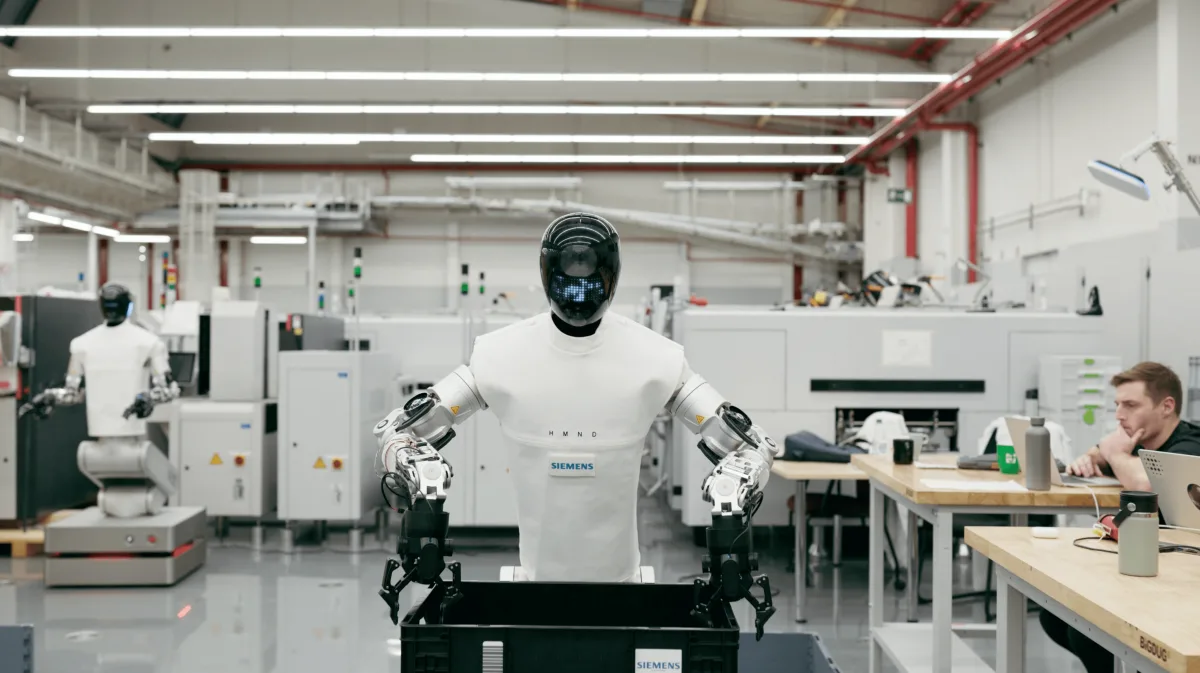
Siemens’ strategic partnership with NVIDIA to deliver artificial intelligence-driven manufacturing sites has reached a watershed moment with the testing of Humanoid robots at a Siemens factory in Germany.
ADVANCING THE PRESENCE OF PHYSICAL AI
Siemens and Humanoid have reached a significant milestone in bringing physical artificial intelligence (AI) into real industrial environments, following the successful testing of a humanoid robot at Siemens’ electronics factory in Erlangen, Germany.
The collaboration builds on Siemens’ strategic partnership with NVIDIA, which aims to develop fully AI-driven, adaptive manufacturing sites.
At the centre of this development is the HMND 01 Alpha, a wheeled humanoid robot designed specifically for industrial use. Built using NVIDIA’s physical AI stack, the robot has been deployed in logistics operations, where it autonomously carried out tote-handling tasks such as picking, transporting, and placing containers.
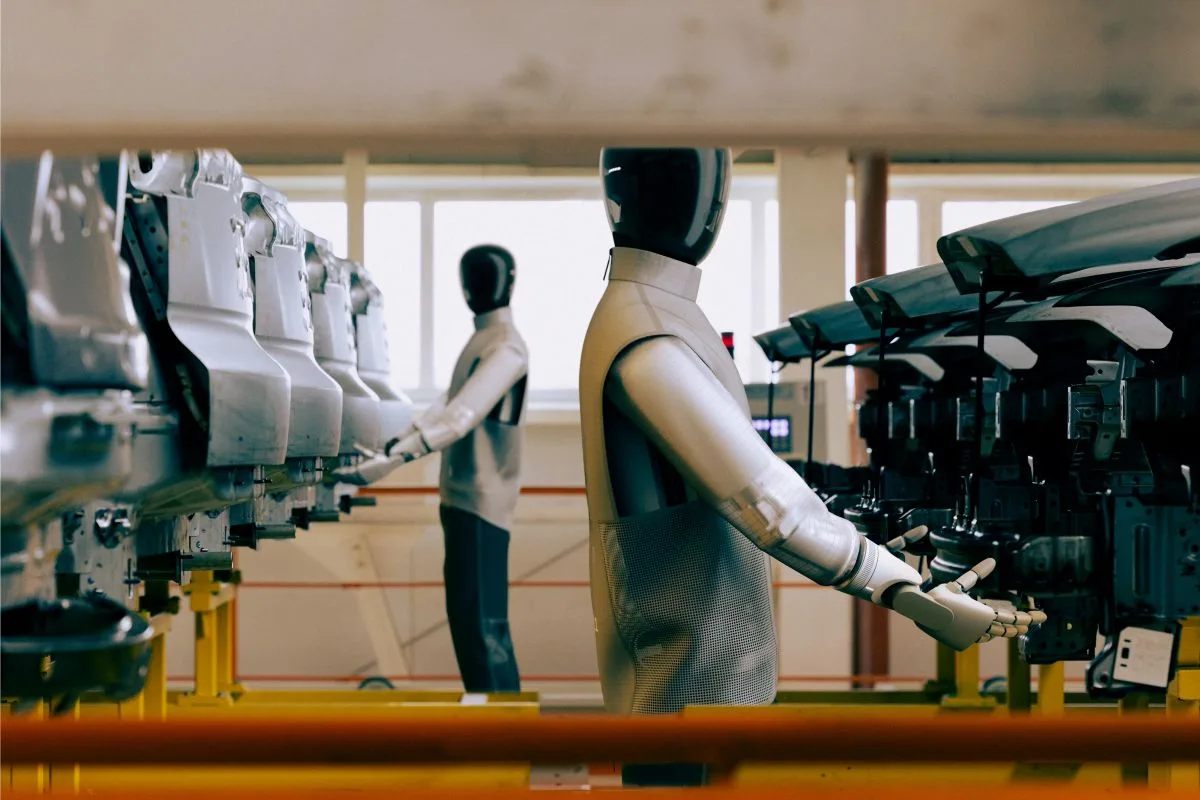
During testing, the robot achieved key performance targets, including a throughput of 60 tote moves per hour, uptime exceeding eight hours, and autonomous pick-and-place success rates above 90 percent.
Physical AI refers to systems that can perceive, reason, and act in real-world environments. Applying this capability to manufacturing requires a combination of advanced computing and simulation, robotics platforms, and industrial automation infrastructure working together as a cohesive ecosystem.
INTEGRATION THROUGH SIEMENS XCELERATOR
Physical AI refers to systems that can perceive, reason, and act in real-world environments. Applying this capability to manufacturing requires a combination of advanced computing and simulation, robotics platforms, and industrial automation infrastructure working together as a cohesive ecosystem.
A key factor in enabling humanoid robots on the shop floor is their integration into existing production systems. This includes real-time data exchange, coordination with machinery and other automated systems, and the ability to adapt dynamically to changing conditions.
Siemens supports this integration through its Siemens Xcelerator portfolio, which includes technologies such as digital twins, AI-enabled perception, control systems, PLC-robot interfaces, fleet management, and industrial communication networks.
Together, these form the digital and automation infrastructure required for scalable deployment in industrial settings.
ACCELERATING DEVELOPMENT WITH NVIDIA
Humanoid has incorporated NVIDIA’s full physical AI stack into the HMND 01 platform, including Jetson Thor for edge computing, Isaac Sim for simulation, and Isaac Lab for reinforcement learning and training.
This approach has significantly reduced development timelines. By using a simulation-first design, the team was able to optimise components such as actuators and joint structures virtually, reducing prototype development time from 18 to 24 months to just seven months.
“Factories of the future demand robots that can perceive, reason, and adapt autonomously alongside human workers, tackling the labour shortages and operational complexity that traditional automation struggled to handle,” comments Deepu Talla, Vice President of Robotics and Edge AI at NVIDIA.
“With Siemens providing the industrial integration backbone and Humanoid deploying NVIDIA’s full physical AI stack – from simulation-first training to real-time edge inference – this deployment paves the way for humanoid robots meeting real production targets on a live factory floor.”
A HUMANOID BUILT FOR INDUSTRIAL ENVIRONMENTS
Humanoid, a UK-based robotics company, developed the HMND 01 Alpha as a robot specifically designed for industrial applications. Combining omnidirectional wheeled mobility with advanced manipulation capabilities and powered by its proprietary KinetIQ AI framework, the robot is intended to operate in human-centric environments and perform a range of complex tasks.

“Our mission is to create humanoid robots that perform not only in controlled lab settings, but also in real-world factory environments, handling meaningful industrial tasks. Our collaboration with Siemens and NVIDIA gives us a powerful advantage by combining NVIDIA’s leading AI infrastructure, simulation tools, and frameworks with Siemens’ deep industrial expertise and integration capabilities,” insights Artem Sokolov, CEO and Founder of Humanoid.
“Together, we’ve proven that humanoid robots are ready for real-world industrial deployment.”
This article was produced by the editorial team at EME Outlook and published as part of the Outlook Publishing global network of B2B industry magazines.
Outlook Publishing delivers industry insights, company stories, and sector coverage across manufacturing, mining, construction, healthcare, supply chains, food production, and sustainability.
EME Outlook provides ongoing coverage of organisations and developments shaping industries across Europe and the Middle East.