



- Flexible plastic packaging driving global pollution
- The potential role of paper-based alternatives
- Safeguards needed to ensure environmental benefits
- Businesses explore next-generation packaging solutions
- Research highlights need for innovation and collaboration
- Paper packaging part of a broader circular economy strategy
- How supply chains play a key role in paper based packaging
Flexible plastic packaging driving global pollution
The report has been endorsed by 47 businesses, NGOs, investors and academics, all supporting efforts to accelerate innovation in paper-based flexible packaging solutions.
Flexible plastics — including sachets, wrappers and pouches — are the fastest-growing type of plastic packaging worldwide. According to the report, these materials represent a major source of pollution in regions with limited waste management infrastructure.
In countries with low formal collection and recycling systems, flexibles make up around 80% of the plastic packaging that ends up in oceans. The report notes that small-format flexible packaging is widely used for everyday products ranging from snacks and shampoo to coffee and milk.
The Foundation warns that, without intervention, an estimated 20 trillion flexible plastic packaging items could enter the oceans over the next 15 years.
The potential role of paper-based alternatives
The report — titled Paper-Based Flexible Packaging – The role it could play in tackling small-format flexible plastic pollution in markets with high leakage rates — suggests paper could provide an alternative to plastic in certain applications.
Paper-based packaging can potentially be designed to be both recyclable and biodegradable. In markets where flexible packaging frequently escapes into the environment, these materials could reduce persistent plastic pollution while still allowing recycling once collection systems improve.
The research highlights that this approach could be particularly relevant in countries such as India, Indonesia, the Philippines, Thailand and Vietnam, where packaging leakage rates are high.
Safeguards needed to ensure environmental benefits
Despite its potential, the report warns that paper packaging must be carefully designed and sourced to avoid creating new environmental problems.
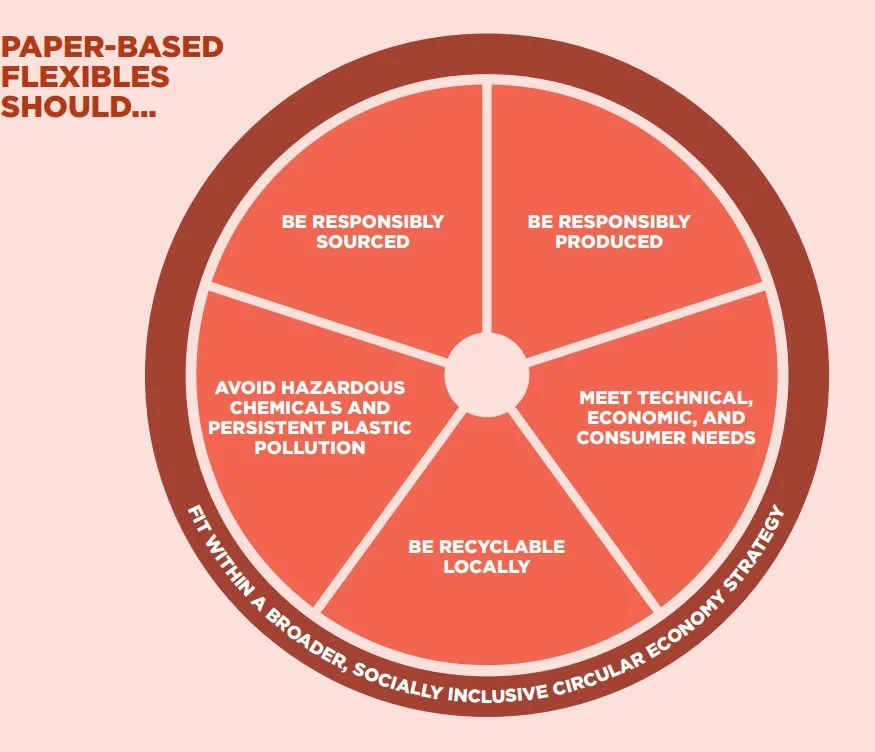
To address this, the report outlines six criteria for responsible paper-based flexible packaging:
- Responsibly sourced to avoid contributing to forest degradation.
- Responsibly produced to minimise pressure on climate and water resources.
- Meets technical, economic, and consumer needs to be viable in practice.
- Recyclable locally and supported by efforts to scale up collection infrastructure.
- Avoids hazardous chemicals and persistent plastic pollution.
- Fits within a broader, socially inclusive circular economy strategy.
Sander Defruyt, Plastics Strategy Lead at the Ellen MacArthur Foundation, said:
“Flexible plastic packaging pollution is a systemic challenge – with an estimated 20 trillion items expected to enter our oceans over the next 15 years. There’s no silver bullet, therefore adding paper-based alternatives to the mix helpfully expands the toolbox, complementing other priority solutions such as reusable packaging.
“This will require major innovation and action from industry and policymakers to speed up development and scaling, guided by the six critical criteria in this report to ensure we don’t replace one problem with another.”
While innovation is progressing, the Foundation notes that paper-based flexible packaging solutions are not yet available at the scale, cost or performance levels required for widespread adoption.
Launched in 2010, the Ellen MacArthur Foundation is an international charity accelerating the transition to a circular economy – one that is globally resilient and thrives within planetary boundaries.
Businesses explore next-generation packaging solutions
Major consumer goods companies are already exploring paper-based packaging technologies.
Pablo Costa, Global Head of Packaging, Digital & Transformation at Unilever, said:
“Next-generation paper-based flexible packaging is a key focus for Unilever and an industry-wide priority.
“This report is clear on the important role paper will play and what it will take to scale solutions that are desirable for consumers, better for the environment, and viable for businesses.”
Allison Lin, Global VP Healthy Planet at Mars said:
“Well-designed, responsibly-sourced paper, as laid out in this report, is one of the viable solutions against plastic pollution.
However, we need more innovation to broaden the scale and applications of paper-based packaging, including coating and adhesive technologies. We hope this report highlights the need for additional investments and innovation into this space, as well as the necessary guardrails.”
Gilles Demaurex, Head of Global Packaging Development at Nestle said:
“Nestlé believes paper-based flexible packaging can play a valuable role in addressing virgin plastic reduction and minimizing flexible packaging waste and pollution.
This report provides stakeholders with a much‑needed common vision and a clear set of criteria to ensure that paper‑based flexible packaging solutions are developed and deployed responsibly. We call on the entire value chain and policymakers to join us in taking action to accelerate innovation aligned with these criteria, while prioritizing collection and recycling systems for all packaging.”
David V Allen, Vice President Sustainable Packaging at Pepsico said:
“Business, governments, financial institutions and civil society all have a role to play to continue to drive packaging circularity.
We hope this report helps align all stakeholders behind a common vision and set of critical criteria to responsibly advance paper-based flexibles as one of the possible levers to support circularity.”
Research highlights need for innovation and collaboration
Experts say innovation across materials, design and supply chains will be needed to make paper-based flexibles viable.
Gaurav Goel, Professor at Indian Institute of Technology Delhi, said:
“This report, backed by evidence and stakeholder input, sets the initial canvas on challenges and critical conditions to turn the promise of paper flexibles into a scalable reality.
“It strongly emphasises the need to combine judicious material choice and radical material innovation with deep collaboration and data-driven assessment for engineering packaging solutions that protect the product and the planet.”
Erin Simon, Vice President and Head, Plastic Waste and Business WWF said:
“Small-format flexible packaging is a significant contributor to plastic pollution, particularly in high leakage markets, making it one of the most pressing challenges we face.
Material substitution has an important role to play in addressing this crisis, but it must be applied thoughtfully — alongside elimination and reuse solutions — to avoid unintended trade-offs. This report provides the much needed guardrails and practical guidance to ensure that any transition to paper-based packaging is pursued responsibly and delivers real environmental and social benefits.”

Paper packaging part of a broader circular economy strategy
The Ellen MacArthur Foundation stresses that paper alternatives represent only one part of a broader strategy to tackle plastic pollution.
Its research prioritises reducing reliance on small-format flexible packaging overall, including scaling reuse models alongside material innovation.
The new report forms part of the Foundation’s wider 2030 Plastics Agenda for Business, which identifies small-format flexible packaging as one of the key systemic barriers to achieving a circular economy for plastics.
How supply chains play a key role in paper based packaging
The report highlights that transitioning to paper-based flexible packaging is not simply a material substitution but a supply chain transformation requiring end-to-end coordination.
From responsibly sourced fibre and certified forestry inputs to converters, brands and retailers, every stage must align to ensure sustainability gains are realised.
The findings also point to significant downstream challenges, particularly the lack of collection, sorting and recycling infrastructure needed to handle paper-based flexibles at scale.
Without these systems, material innovation risks shifting environmental impacts upstream rather than reducing them.