



Manufacturers continued to increase safety stock in June as shortages of critical inputs and rising order backlogs kept global supply chains under pressure, according to the latest GEP Global Supply Chain Volatility Index. Procurement teams in North America and Asia maintained strong purchasing activity, while European manufacturers reduced buying volumes.
Supply chain pressures remain elevated
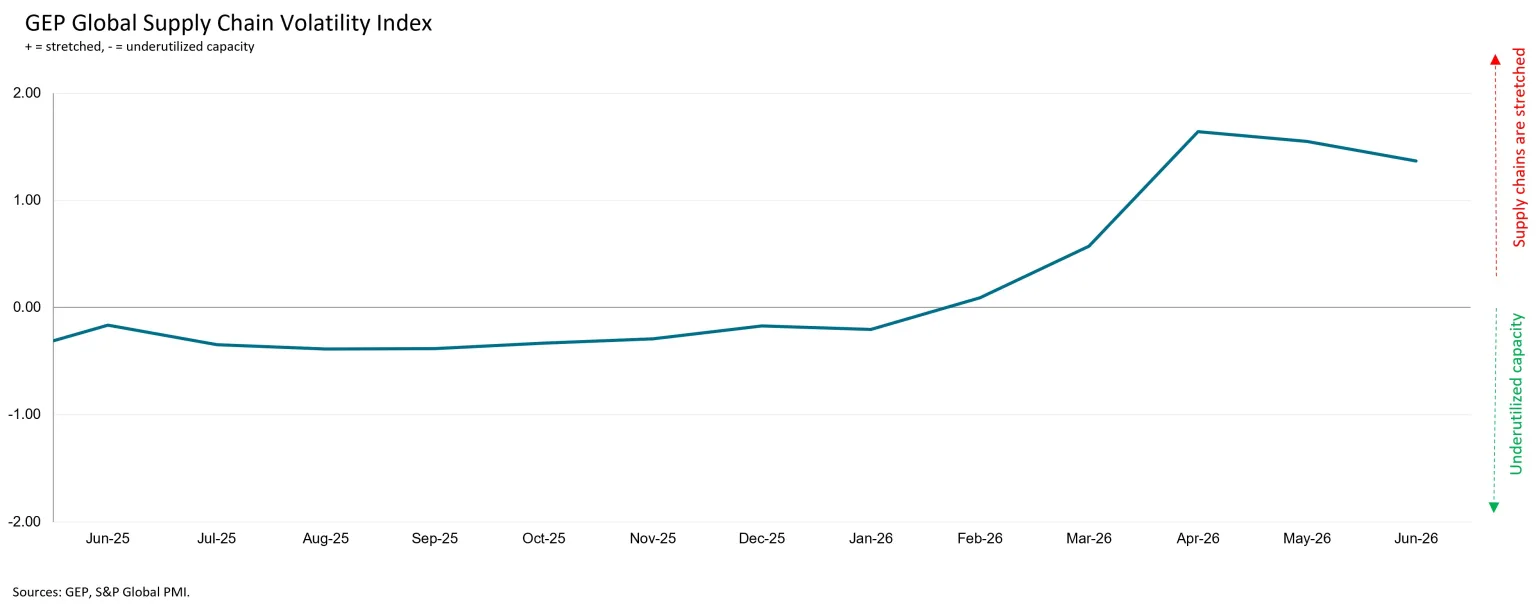
Global supply chain pressures remained elevated in June despite lower oil prices and easing transportation costs, according to the latest GEP Global Supply Chain Volatility Index.
The monthly index, based on a survey of 27,000 businesses, found that uncertainty surrounding the US-Iran ceasefire in the Strait of Hormuz continued to influence procurement and supply chain activity.
Manufacturers reported the highest level of order backlogs caused by shortages of critical inputs since late 2022, indicating that supply chain bottlenecks are likely to persist into at least the third quarter.
Procurement teams increase buffer inventories
Manufacturers continued building buffer inventories during June to reduce the risk of further disruption.
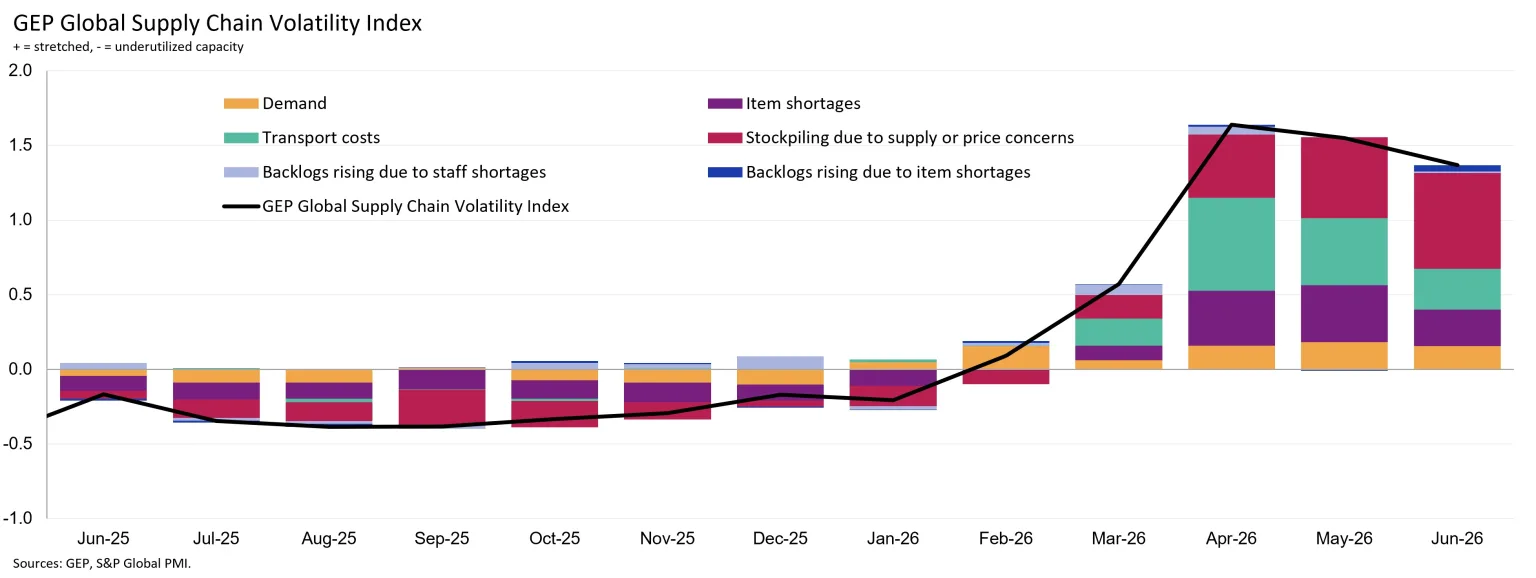
Reports of safety stockpiling increased again and remained at their highest level since January 2023, while demand for raw materials, commodities and intermediate goods remained strong across North America and Asia.
In contrast, European manufacturers reduced input purchasing during the month.
“The rise in stockpiling and persistent order backlogs point to one clear conclusion: businesses still don’t trust the global trading environment to remain stable,” said John Piatek, Vice President, Consulting, GEP.
“Despite lower oil prices and easing transportation costs, companies continue buying ahead because they expect further disruption. While this is encouraging for the global economy in the near term, it also shows manufacturers remain very cautious and are planning for more disruption in international trade.”

Regional supply chain trends
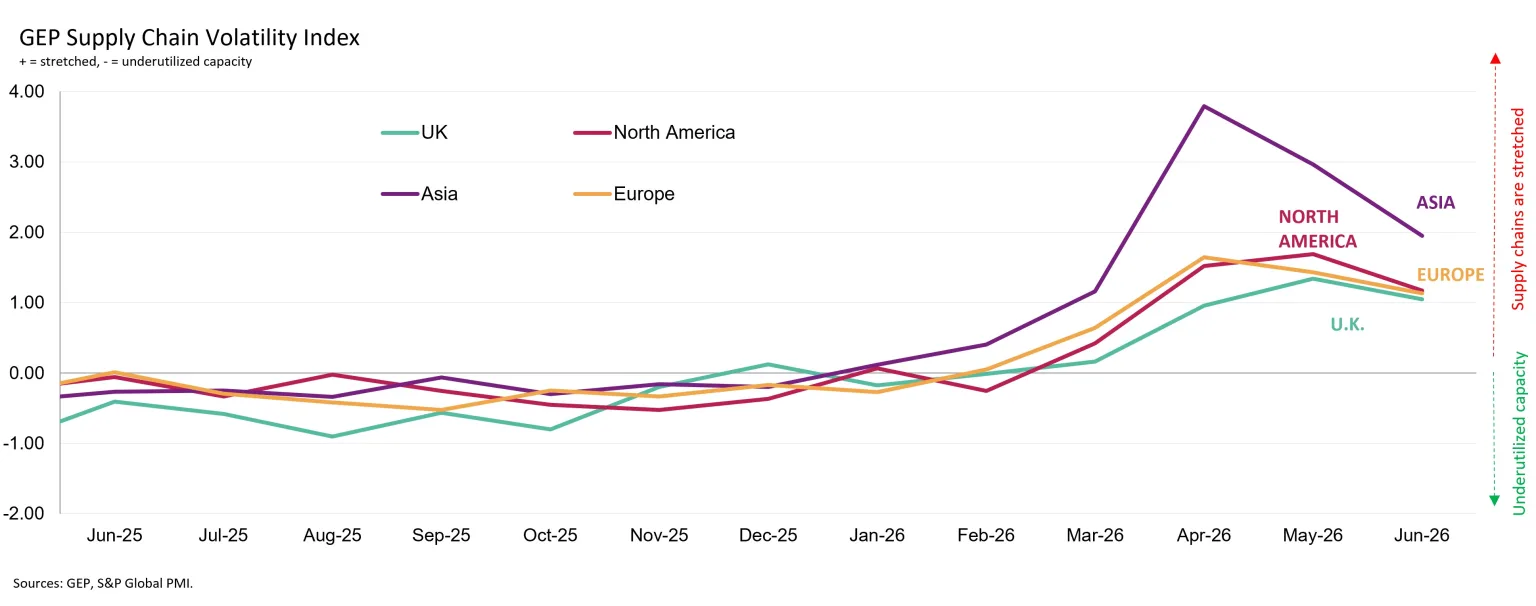
- The GEP Global Supply Chain Volatility Index remained above zero across all major regions in June, indicating that supply chain capacity continued to be stretched.
- Asia recorded an index reading of 1.95, down from 2.96 in May and its lowest level since March. GEP attributed the decline primarily to easing transportation cost inflation.
- North America’s index declined to 1.17 from 1.69, also a three-month low. Despite the easing in overall supply chain pressure, manufacturers significantly increased purchasing activity in response to shortages of critical items and growing order backlogs.
- Europe’s index fell to 1.13 from 1.43. Manufacturers reduced purchasing volumes to the greatest extent since the outbreak of the Middle East war, although inventory levels continued to increase.
- The UK index declined to 1.05 from 1.34, its lowest level since April, as manufacturers reduced activity.
Purchasing activity remains resilient
Demand for production inputs remained strong globally during June, driven primarily by North America and Asia.
In the United States, manufacturers increased purchases of raw materials, commodities and intermediate goods at the fastest rate since April 2022. Purchasing activity also accelerated in Japan, China and Vietnam.
The report found that European manufacturers moved in the opposite direction, reducing purchasing volumes during the month.
Inventory strategies and material shortages
Inventory growth continued as procurement teams sought to protect operations against future supply disruptions and price increases.
Reports of stockpiled materials increasing due to supply or pricing concerns reached their highest level since January 2023, extending the sustained rise seen since the Middle East war began.
Although the indicator measuring material shortages declined during June, suggesting some improvement in global supply availability, shortages remained elevated compared with historical averages. Manufacturers also reported that work backlogs continued to rise because of inadequate availability of critical inputs.
Transportation and labour conditions
Transportation costs declined during June following a sharp fall in global oil prices. However, GEP said transportation costs remained high by historical standards and, excluding April and May, were at their highest level since June 2022.
Labour shortages were less of a constraint on manufacturing capacity. Reports of production backlogs caused by workforce shortages remained broadly in line with historical averages.
What is the GEP Global Supply Chain Volatility Index
The GEP Global Supply Chain Volatility Index is produced by S&P Global and GEP. It is derived from S&P Global’s PMI surveys, sent to companies in over 40 countries, totalling around 27,000 companies. The headline figure is a weighted sum of six sub-indices derived from PMI data, PMI Comments Trackers and PMI Commodity Price & Supply Indicators compiled by S&P Global.
- A value above 0 indicates that supply chain capacity is being stretched and supply chain volatility is increasing. The further above 0, the greater the extent to which capacity is being stretched.
- A value below 0 indicates that supply chain capacity is being underutilised, reducing supply chain volatility. The further below 0, the greater the extent to which capacity is being underutilised.
This article was produced by the editorial team at EME Outlook and published as part of the Outlook Publishing global network of B2B industry magazines.
Outlook Publishing delivers industry insights, company stories, and sector coverage across manufacturing, mining, construction, healthcare, supply chains, food production, and sustainability.
EME Outlook provides ongoing coverage of organisations and developments shaping industries across Europe and the Middle East.