Lucy Pilgrim is an in-house writer for EME Outlook Magazine, where she is responsible for interviewing corporate executives and crafting original features for the magazine, corporate...
- Deputy Head of Editorial
Share
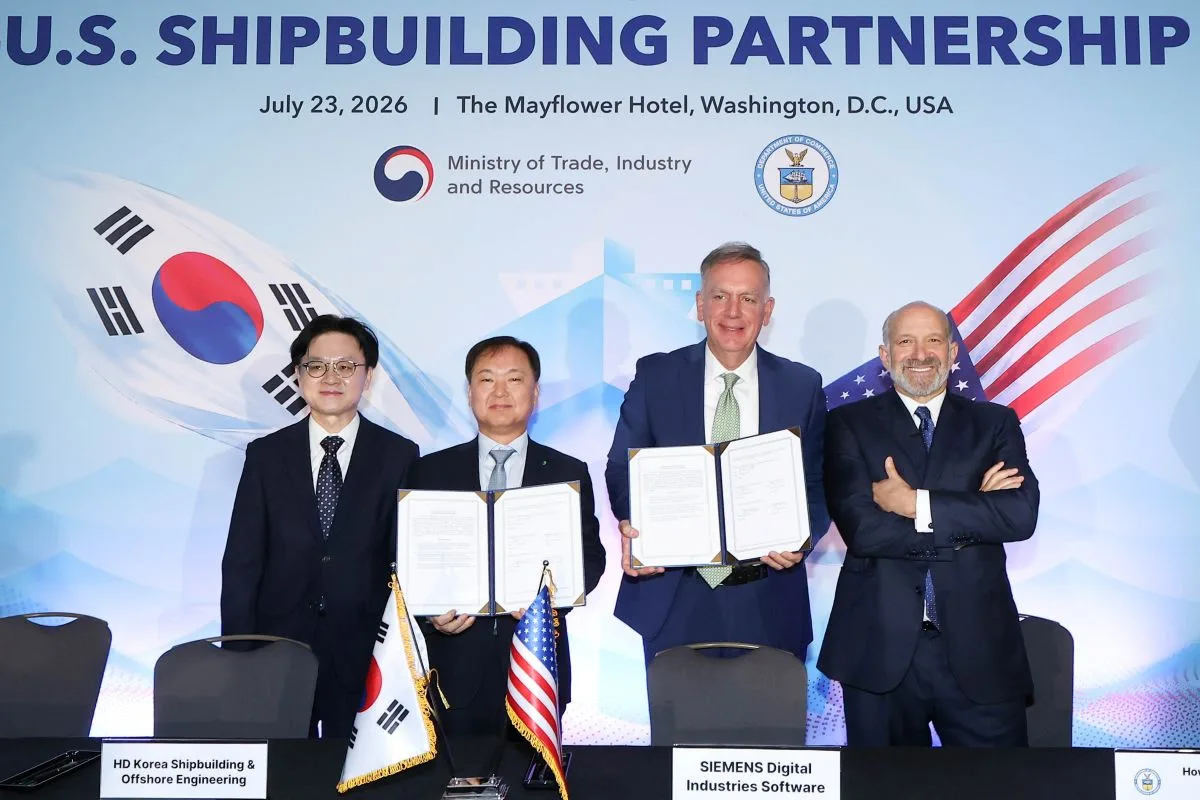
Siemens and HD Hyundai have strengthened their strategic partnership to develop a blueprint for the digital shipyard, combining industrial software, automation, and artificial intelligence to help modernise global shipbuilding and meet growing international demand.
Siemens and HD Hyundai have announced an expanded strategic partnership aimed at transforming the future of shipbuilding through the creation of a digital shipyard blueprint.
The collaboration is underpinned by a low-triple-digit million USD agreement that will see HD Hyundai adopt the Siemens Xcelerator portfolio of industrial software and automation. Together, the companies aim to address increasing global demand for greater shipbuilding capacity and modernised production capabilities across the US and other international markets.
The initiative will establish a connected digital thread spanning engineering, manufacturing, suppliers, and shipyard operations. By bringing these areas together, the partnership seeks to enable artificial intelligence (AI)-powered insights, intelligent automation and data-driven decision-making throughout the entire shipbuilding lifecycle.
DRIVING PRODUCTIVITY THROUGH DIGITALISATION
The integrated digital backbone is designed to help shipbuilders increase production capacity whilst improving quality and reducing rework. By creating a more connected and efficient operating environment, the companies intend to support a more resilient shipbuilding ecosystem capable of responding to rising global demand.
The digital shipyard model has also been designed to support both new shipyard developments and phased modernisation programmes, allowing existing facilities to introduce digital technologies without interrupting day-to-day operations.
“AI is not merely a tool for improving productivity, but a transformative technology that is reshaping how ships are designed, built, and operated. By integrating AI, digital twin, and automation technologies into a connected digital shipyard environment, we aim to establish a future-ready model for the shipbuilding industry,” said H.K. Kim, President and CEO of HD Korea Shipbuilding & Offshore Engineering.
“Together with Siemens, we look forward to helping accelerate the digital transformation of shipyards worldwide, while contributing to the modernization and competitiveness of the U.S. shipbuilding industry.”
H.K. Kim, President and CEO, HD Korea Shipbuilding & Offshore Engineering
Roland Busch, President and CEO of Siemens AG, highlighted the complexity involved in modern shipbuilding and the role digital technologies can play in streamlining production.
“To build the world’s most advanced vessels, shipbuilders must manage enormous complexity across millions of components. Through our extended partnership with HD Hyundai, we are creating a scalable blueprint for the digital shipyard of the future, with Siemens Xcelerator at its core,” he said.
“By connecting data, software and automation across the shipyard, we are building the operating system for industrial AI – helping shipbuilders increase capacity, improve quality and reduce rework.”
Alongside the digital shipyard initiative, Siemens and HD Hyundai will support the launch of a US-Korea Shipbuilding Technology Cooperation Center in Washington, D.C.
The centre is intended to encourage closer collaboration between government, industry, and technology organisations while providing a platform to explore shipyard modernisation strategies. It will also focus on accelerating the adoption of digital shipyard technologies and supporting workforce and industrial development initiatives that strengthen maritime competitiveness across the US and allied markets.
Through the Siemens Xcelerator portfolio, HD Hyundai will gain access to software and technologies that support controlled data sharing, configuration management, digital approvals, production visibility, and lifecycle traceability. These capabilities are designed to maintain design authority and execution responsibility across a range of shipbuilding scenarios while creating a more connected and digitally enabled production environment.
This article was produced by the editorial team at EME Outlook and published as part of the Outlook Publishing global network of B2B industry magazines.
Outlook Publishing delivers industry insights, company stories, and sector coverage across manufacturing, mining, construction, healthcare, supply chains, food production, and sustainability.
EME Outlook provides ongoing coverage of organisations and developments shaping industries across Europe and the Middle East.
Lucy Pilgrim is an in-house writer for EME Outlook Magazine, where she is responsible for interviewing corporate executives and crafting original features for the magazine, corporate brochures, and the digital platform.